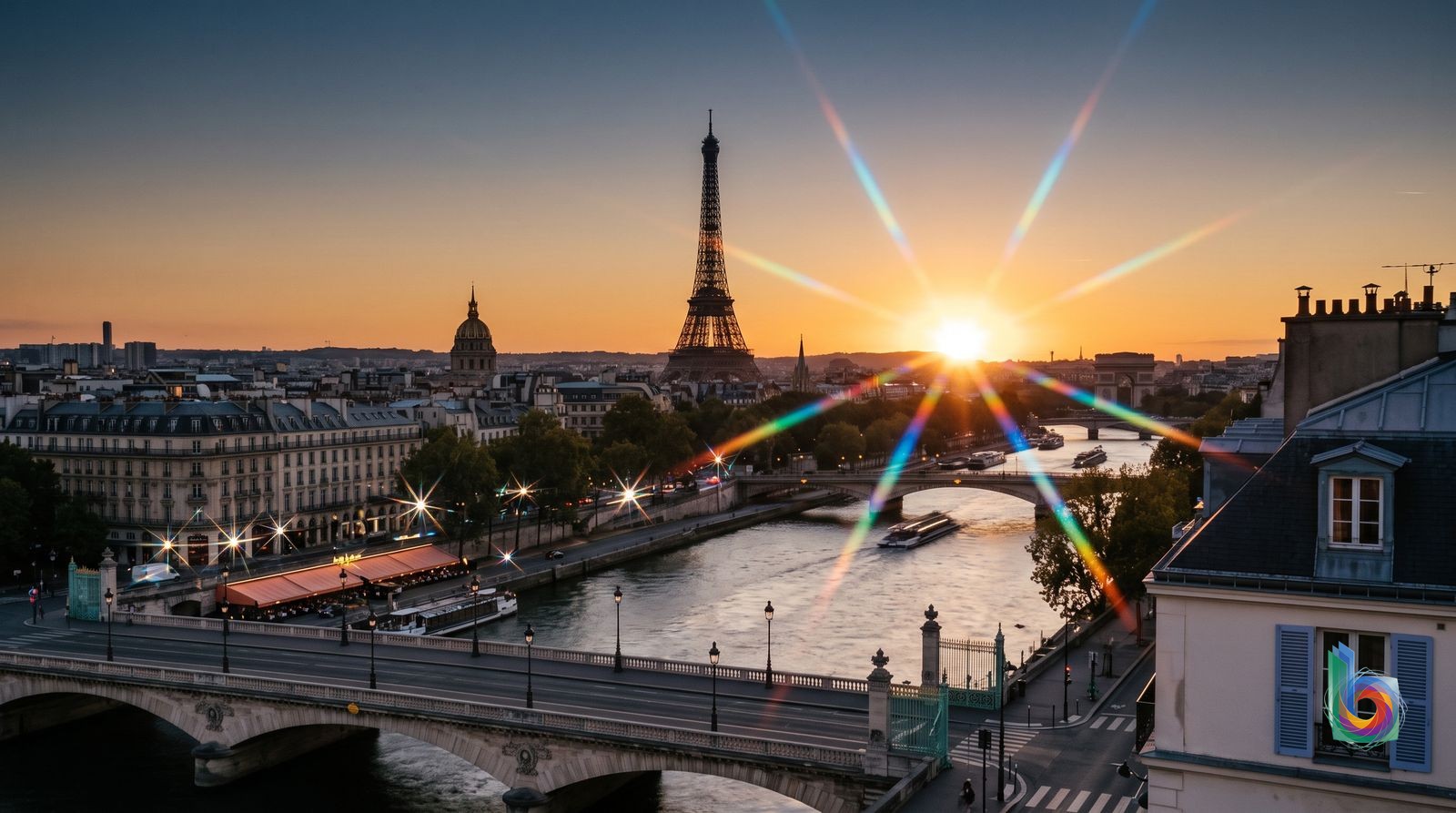
The Eiffel Tower, Arc de Triomphe, Notre-Dame and the monumental Seine skyline · The Louvre, Musée d’Orsay, Sainte-Chapelle and an exceptional density of art and architecture · French cooking at every level, from serious bakeries and markets to Michelin-starred dining · Fashion, design, perfume and luxury houses including Chanel, Dior and Guerlain
Paris is a compact municipal core of about 2 million people on the Seine, but it is also the centre of a metropolitan region of roughly 13 million: a working capital, university city, political stage and transport hub, not a museum with café tables. It earned “City of Light” as much from the Enlightenment as from its street lighting, and its real strengths are the collision of art, food, fashion, ideas and everyday neighbourhood life. The trap is treating the Eiffel Tower–Louvre–Montmartre circuit as the whole place: it is magnificent, but it is also the most crowded, expensive and least restful version of Paris.
The mental map
The 20 arrondissements spiral clockwise outward from the 1st, around the Louvre; lower numbers are generally more central, but that is not a quality ranking. The Seine divides the Right Bank (north: Louvre, Marais, Opéra, Montmartre) from the Left Bank (south: Latin Quarter, Saint-Germain, Invalides), while Île de la Cité and Île Saint-Louis sit in the middle. The Boulevard Périphérique marks the legal edge of Paris; places such as Versailles, La Défense and Saint-Denis are functionally connected but outside it. Métro lines 2 and 6 form the useful elevated-or-underground inner loop, while RER lines are the fast spokes for airports, Versailles and the suburbs.
Pacing
Plan two major ticketed sights a day, not five. Paris is walkable but museums are enormous, timed-entry queues consume time, and the best parts—river walks, markets, neighbourhood wandering and long meals—do not reward checklist travel. One anchor museum or monument plus one neighbourhood/landmark area is a good day; the Louvre alone can justify most of a day.
Numbered pins are the top sights — tap one for details.
Notre-Dame is the essential Gothic landmark and the natural anchor for an Île de la Cité walk. Go inside if the line and your schedule allow, then spend time viewing its exterior, apse, and river setting rather than rushing straight onward.
The monument is imposing at street level, but its real payoff is the rooftop view down the radiating avenues, including the Champs-Élysées toward the Louvre. It is a better viewpoint than a long stop on the avenue itself.
The Louvre is a defining first-trip sight, but it rewards a focused plan far more than an attempt to see everything. Pick one or two wings, allow time for the building itself, and accept that the Mona Lisa is only one stop.
It is the unavoidable Paris symbol, and first-timers should either go up once or deliberately enjoy it from the surrounding riverfront and Trocadéro. The experience is strongest when scheduled, not improvised around a long ticket queue.
Sacré-Cœur earns its place for the hilltop panorama and the distinctive Montmartre setting rather than for a long interior visit. Pair it with an unhurried wander on the streets behind the basilica, while avoiding an overlong stay in the tourist-clogged Place du Tertre.
The upper chapel’s stained glass is one of Paris’s most memorable interiors and is a stronger art-and-architecture experience than its small footprint suggests. Time it with the Conciergerie on the same security-controlled complex.
It gives a first-time visitor the strongest balance of central walking access, genuine historic fabric, dining, evening life and multiple Métro options. It is expensive and crowded, but it wastes less sightseeing time than a peripheral bargain hotel and feels more lived-in than the monument-only core.
Where to eat
Tables worth crossing town for
Costs nothing
Free and great
Walk the Seine from Île Saint-Louis or Notre-Dame west through the booksellers and quays toward the Louvre; the river is Paris’s best free gallery, especially early morning or near dusk.
Climb through Montmartre to Sacré-Cœur for the city view, then leave the Place du Tertre crowds quickly for the lanes behind the basilica. Entry to the basilica itself is free; the dome is not.
Wander the Marais: Place des Vosges, Hôtel de Sully’s courtyard and the streets around Rue des Rosiers give you medieval and aristocratic Paris without a ticket.
Visit Père-Lachaise Cemetery for its sculptural tombs, trees and graves including Oscar Wilde, Chopin and Jim Morrison. It is free, but treat it as a cemetery rather than a scavenger hunt.
Use the Promenade Plantée/Coulée verte René-Dumont, the elevated planted walkway beginning near Bastille, for a quieter alternative to the Seine and a view into eastern Paris rooftops.
Spend time in Luxembourg Gardens, the Tuileries or Parc des Buttes-Chaumont; the latter is the most dramatic and least postcard-obvious choice.
Visit the permanent collections of the Musée Carnavalet, the Paris-history museum, and the Mémorial de la Shoah; both offer free entry to their permanent displays.
On the first Sunday of each month, national museums and monuments are generally free for all visitors. Check the individual institution’s current reservation and exhibition rules before building a day around it: free days can be crowded and some timed slots still need booking.
The Eiffel Tower, Arc de Triomphe, Notre-Dame and the monumental Seine skyline · The Louvre, Musée d’Orsay, Sainte-Chapelle and an exceptional density of art and architecture · French cooking at every level, from serious bakeries and markets to Michelin-starred dining · Fashion, design, perfume and luxury houses including Chanel, Dior and Guerlain
Paris is a compact municipal core of about 2 million people on the Seine, but it is also the centre of a metropolitan region of roughly 13 million: a working capital, university city, political stage and transport hub, not a museum with café tables. It earned “City of Light” as much from the Enlightenment as from its street lighting, and its real strengths are the collision of art, food, fashion, ideas and everyday neighbourhood life. The trap is treating the Eiffel Tower–Louvre–Montmartre circuit as the whole place: it is magnificent, but it is also the most crowded, expensive and least restful version of Paris.
The mental map
The 20 arrondissements spiral clockwise outward from the 1st, around the Louvre; lower numbers are generally more central, but that is not a quality ranking. The Seine divides the Right Bank (north: Louvre, Marais, Opéra, Montmartre) from the Left Bank (south: Latin Quarter, Saint-Germain, Invalides), while Île de la Cité and Île Saint-Louis sit in the middle. The Boulevard Périphérique marks the legal edge of Paris; places such as Versailles, La Défense and Saint-Denis are functionally connected but outside it. Métro lines 2 and 6 form the useful elevated-or-underground inner loop, while RER lines are the fast spokes for airports, Versailles and the suburbs.
Pacing
Plan two major ticketed sights a day, not five. Paris is walkable but museums are enormous, timed-entry queues consume time, and the best parts—river walks, markets, neighbourhood wandering and long meals—do not reward checklist travel. One anchor museum or monument plus one neighbourhood/landmark area is a good day; the Louvre alone can justify most of a day.
Numbered pins are the top sights — tap one for details.
Notre-Dame is the essential Gothic landmark and the natural anchor for an Île de la Cité walk. Go inside if the line and your schedule allow, then spend time viewing its exterior, apse, and river setting rather than rushing straight onward.
The monument is imposing at street level, but its real payoff is the rooftop view down the radiating avenues, including the Champs-Élysées toward the Louvre. It is a better viewpoint than a long stop on the avenue itself.
The Louvre is a defining first-trip sight, but it rewards a focused plan far more than an attempt to see everything. Pick one or two wings, allow time for the building itself, and accept that the Mona Lisa is only one stop.
It is the unavoidable Paris symbol, and first-timers should either go up once or deliberately enjoy it from the surrounding riverfront and Trocadéro. The experience is strongest when scheduled, not improvised around a long ticket queue.
Sacré-Cœur earns its place for the hilltop panorama and the distinctive Montmartre setting rather than for a long interior visit. Pair it with an unhurried wander on the streets behind the basilica, while avoiding an overlong stay in the tourist-clogged Place du Tertre.
The upper chapel’s stained glass is one of Paris’s most memorable interiors and is a stronger art-and-architecture experience than its small footprint suggests. Time it with the Conciergerie on the same security-controlled complex.
It gives a first-time visitor the strongest balance of central walking access, genuine historic fabric, dining, evening life and multiple Métro options. It is expensive and crowded, but it wastes less sightseeing time than a peripheral bargain hotel and feels more lived-in than the monument-only core.
Where to eat
Tables worth crossing town for
Costs nothing
Free and great
Walk the Seine from Île Saint-Louis or Notre-Dame west through the booksellers and quays toward the Louvre; the river is Paris’s best free gallery, especially early morning or near dusk.
Climb through Montmartre to Sacré-Cœur for the city view, then leave the Place du Tertre crowds quickly for the lanes behind the basilica. Entry to the basilica itself is free; the dome is not.
Wander the Marais: Place des Vosges, Hôtel de Sully’s courtyard and the streets around Rue des Rosiers give you medieval and aristocratic Paris without a ticket.
Visit Père-Lachaise Cemetery for its sculptural tombs, trees and graves including Oscar Wilde, Chopin and Jim Morrison. It is free, but treat it as a cemetery rather than a scavenger hunt.
Use the Promenade Plantée/Coulée verte René-Dumont, the elevated planted walkway beginning near Bastille, for a quieter alternative to the Seine and a view into eastern Paris rooftops.
Spend time in Luxembourg Gardens, the Tuileries or Parc des Buttes-Chaumont; the latter is the most dramatic and least postcard-obvious choice.
Visit the permanent collections of the Musée Carnavalet, the Paris-history museum, and the Mémorial de la Shoah; both offer free entry to their permanent displays.
On the first Sunday of each month, national museums and monuments are generally free for all visitors. Check the individual institution’s current reservation and exhibition rules before building a day around it: free days can be crowded and some timed slots still need booking.